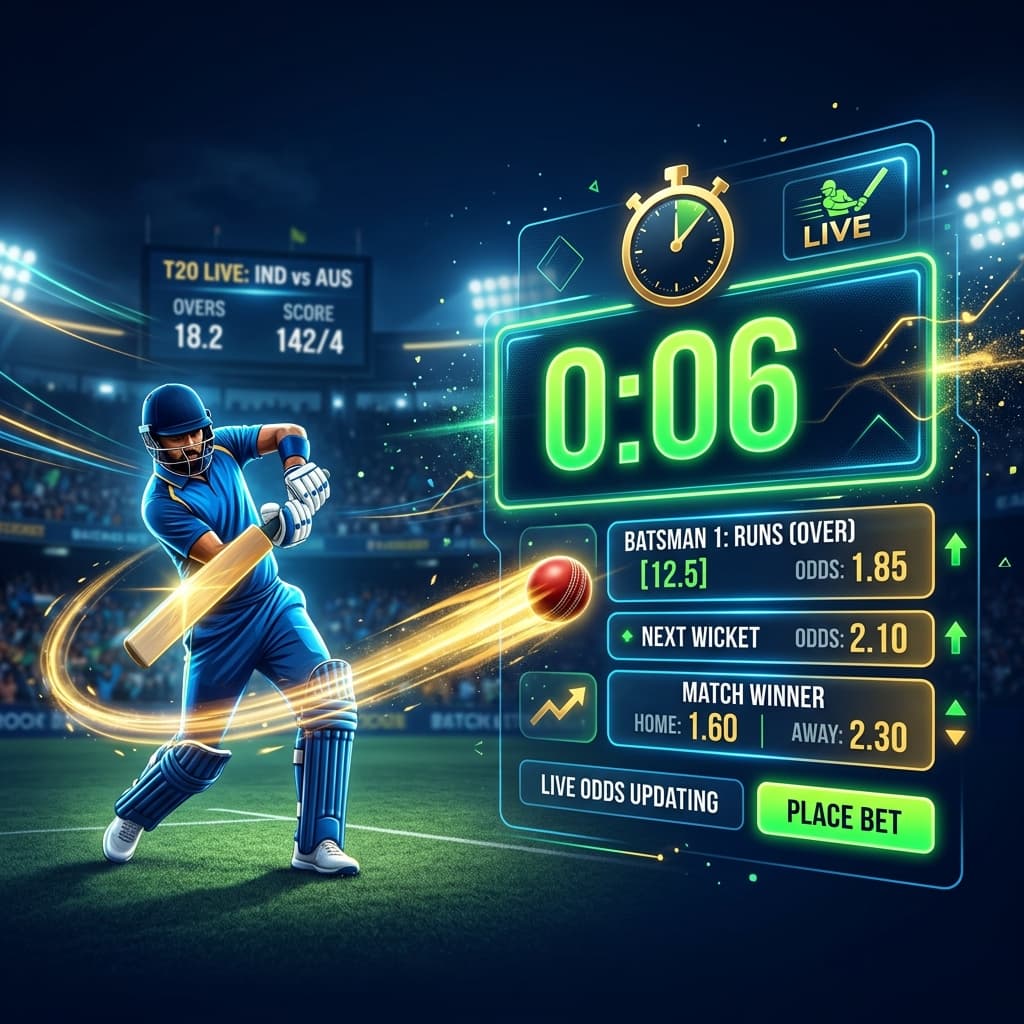
Most cricket bettors make their decision before the toss. They study the pitch report, check the rankings, pick a side, and then sit back and watch events unfold on a surface they can no longer influence. That is a reasonable approach. It is also, according to a growing body of evidence from professional sports bettors, exactly backwards.
The edge in modern cricket betting is not in predicting the toss or reading the morning pitch report. It is in the six seconds after a wicket falls at 14.3 overs, when the scoreboard has registered the event, the crowd is still mid-roar, and the bookmaker’s algorithm has not yet finished deciding what the match is now worth.
That window — brief, specific, and available to anyone with a fast enough connection and a focused enough mind — is what this piece is about.
What Is the Six-Second Rule?
In live betting, every significant on-field event triggers a repricing process. A wicket falls, and the chasing team’s odds lengthen. A six is hit off the first ball of the final over, and the total runs market shifts. A key all-rounder gets run out, and the match winner market swings several points in under a minute.
The six-second rule describes the lag between the moment an event occurs on the pitch and the moment that event is reflected in the bookmaker’s live odds.
During that lag, the old odds are still live and available to back. A bettor watching a live stream in real time — rather than relying on a score update service — sees the wicket fall before the algorithm does. If they already have the market loaded and know which side they want to back, they can place a bet at odds that no longer reflect the actual match situation.
Six seconds is an approximation. In practice, the window varies between bookmakers, formats, and the technology stack each operator uses. Some books reprice in as few as three seconds; others take eight to twelve. The “six-second rule” has become the shorthand used among in-play bettors to describe this class of opportunity — and the discipline required to exploit it consistently.
This is not a loophole. It is a structural feature of how live betting markets work, and it is the primary reason professional in-play bettors are watching the match on a dedicated screen rather than checking their phones between overs.
Why Does the Window Exist?
Understanding why the window exists is essential to using it correctly.
Bookmakers do not watch live cricket the way you and I do. Their odds are driven by automated algorithms that ingest data from official scoring feeds — typically provided by companies like Sportradar or Genius Sports. These data feeds capture ball-by-ball events and transmit them to the bookmaker’s pricing engine, which then recalculates odds and updates the market.
The delay is built into that chain at multiple points:
| Step in the Chain | Approximate Delay |
|---|---|
| Ball played on pitch | 0 seconds |
| Official scorer inputs the event | 1–2 seconds |
| Data feed transmits to bookmaker | 2–4 seconds |
| Bookmaker algorithm recalculates odds | 1–2 seconds |
| Updated odds appear on screen | 1 second |
| Total lag from event to new odds | 5–9 seconds |
A bettor watching a good-quality live stream — particularly a broadcast feed rather than a compressed streaming service — typically receives the video within 1–3 seconds of the actual event. That means a well-prepared in-play bettor consistently sees a wicket, a dropped catch, or a run-out before the bookmaker’s odds have updated to reflect it.
The gap is real. It is not exploitable every time, or even most of the time. But for bettors who know which events matter most, who have the market pre-loaded, and who have already decided what they would do in each scenario, it is a genuine and repeatable opportunity.
The Moments That Matter Most
Not every on-field event creates a useful window. A dot ball, a fielding error with no run attempted, or a straightforward single does not produce a significant odds movement — meaning even if you got there before the algorithm, the bet you’d place wouldn’t be advantageous.
The moments that generate meaningful repricing gaps are the ones with binary, high-impact outcomes:
| Event | Market Affected | Odds Impact | Typical Window |
|---|---|---|---|
| Wicket of a key batter (top 3) | Match Winner, Chase O/U | Large (5–20+ points) | 4–8 seconds |
| Six hit off a difficult ball | Total Runs O/U, Momentum | Medium (2–8 points) | 3–6 seconds |
| Run-out (unexpected) | Match Winner | Large (unpredictable) | 5–10 seconds |
| Dropped catch (survival) | Match Winner, Top Batsman | Medium (batter likely to accelerate) | 4–7 seconds |
| Final over starts, close match | Total Runs O/U, Match Winner | Large (context-dependent) | 3–5 seconds |
| Maiden over in a T20I run-chase | Chase O/U, Match Winner | Medium–Large | 4–8 seconds |
The highest-value window consistently appears after the dismissal of a top-order batter in a T20I run-chase. When a team needs 74 off 8 overs and loses their best batter, the required run rate instantly becomes harder to achieve — but the bookmaker’s odds may still show the chasing team at near-pre-wicket prices for several seconds. That is the window.
How Smart Bettors Use the Window
Exploiting the six-second window is not about reflexes alone. Preparation before the window opens determines whether you can act intelligently within it. Bettors who use this approach successfully describe their process in three phases:
- Before the critical moment: Know the match situation deeply before each over begins. What is the required run rate? Which batter is most important to the chasing team? Which bowler is most likely to take a wicket in this spell? By answering these questions at the start of each over, you compress the decision you need to make in the window from “what should I do?” to simply “now.”
- Have the market pre-loaded: The match winner or total runs market should already be open on your device. If you need to navigate to the market after the event, the window is already closed.
- During the window: Act on the pre-made decision, not on emotion. The window is too short for fresh analysis. If you had already decided that losing Batter X would make the chasing team unlikely to win, and Batter X is now walking back to the pavilion, back the fielding team. The thinking was done before the moment arrived.
- After the window: Do not chase the next moment. The temptation after a successful in-play bet is to immediately look for the next opportunity. The bookmaker’s algorithm has now repriced. The advantage is gone. Wait for the next setup to develop, or leave the market entirely.
The Risks Nobody Tells You About
The six-second rule is not a guaranteed profit mechanism, and presenting it as one would be dishonest. Three risks are serious enough to require understanding before attempting any of this.
- Account Restrictions: Bookmakers actively monitor in-play betting patterns. Accounts that consistently place bets in the seconds immediately following high-impact events at pre-event odds are flagged by automated systems. Many experienced in-play bettors report having their stakes restricted or their accounts reviewed after sustained use of this approach. This is legal — operators reserve the right to limit accounts — but it is a real consequence.
- Bet Delays and Voids: Bet delay and void rules apply in almost every market. Most bookmakers impose a mandatory bet delay on live markets — typically between two and five seconds — precisely to counter this pattern. During that delay, the market may be suspended and your bet rejected. Additionally, bets placed during a dead ball (a no-ball being called, for example) are often voided, even if accepted by the system.
- Emotional Speed: The emotional speed of in-play betting is its own risk. Decisions made in three seconds, under the pressure of a close match and real money on the line, are qualitatively different from decisions made calmly before the game. The six-second rule requires disciplined pre-planning; without it, in-play betting produces reactive, loss-chasing decisions at a rate far higher than pre-match betting does.
Does It Actually Work? What the Data Suggests
No large-scale public study on six-second window betting exists — partly because the bettors who use it most effectively have little incentive to publish their results. What does exist is consistent anecdotal evidence from professional betting communities and a reasonable theoretical basis in market microstructure.
The table below compares the general characteristics of pre-match and in-play betting across the variables that matter most:
| Variable | Pre-Match Betting | In-Play (Window) Betting |
|---|---|---|
| Information advantage | Low (public data) | Medium–High (live observation) |
| Speed requirement | None | High |
| Margin efficiency | High (book margins apply) | Variable (stale odds may be used) |
| Account restriction risk | Low | Medium–High |
| Emotional pressure | Low | High |
| Applicability to beginners | High | Low |
The honest conclusion: the six-second window is real, it is exploitable in specific circumstances, and it requires significantly more preparation and discipline than pre-match betting. For the majority of recreational cricket bettors, the risk of emotional over-betting in the live environment outweighs the theoretical edge the window provides.
For bettors who approach cricket betting methodically — with pre-game analysis, a clear plan for each key moment, and strict stake discipline — in-play betting around the moments listed in this piece represents the most data-rich environment available. The market is moving fastest, the information is most current, and the brief lag between reality and price is at its widest.
The six seconds are there. What you do with them is a function of how much work you put in during the six hours before.
Frequently Asked Questions
What exactly is in-play cricket betting?
In-play or live betting allows you to place bets on a cricket match after it has started, with odds updating in real time to reflect the current match situation. Markets typically include match winner, total runs over/under, next dismissal, and method of wicket. Most major licensed bookmakers offer in-play cricket markets on international fixtures and top domestic leagues including the IPL, The Hundred, and the Big Bash League.
Is the six-second rule the same as arbitrage betting?
Not exactly. Arbitrage betting involves covering all outcomes across multiple bookmakers to guarantee a profit regardless of result. The six-second rule describes a different concept — acting on a single bookmaker’s stale odds before they reprice after a live event. The two approaches share a reliance on speed and preparation, but differ in structure and risk profile.
Can bookmakers stop me from using this approach?
Yes. Most major bookmakers include terms that allow them to void bets placed on clearly incorrect prices or to restrict accounts that show patterns consistent with latency exploitation. The degree to which this is enforced varies significantly between operators. Betting exchanges — where you bet against other bettors rather than the house — are generally more tolerant of in-play strategies, and many experienced in-play bettors operate on exchange platforms for this reason.
Which format of cricket is best for in-play betting?
T20I cricket is the most active in-play format because every ball can change the match state significantly, creating multiple repricing events per over. However, its volatility also makes emotional decisions more likely. ODI cricket produces slightly fewer high-impact moments per over but rewards bettors who can track run-rate pressure methodically across 50 overs. Test cricket has a distinct in-play dynamic driven by session momentum rather than over-by-over events.
Related Content
Disclaimer: This article is intended for informational and educational purposes only. Sports betting involves financial risk and is not suitable for everyone. Always bet within your means and only on licensed, regulated platforms. If gambling is affecting you or someone you know, visit begambleaware.org or call the National Gambling Helpline on 0808 8020 133 (free, 24 hours).
Last updated on 5 August 2026: Initial publication.